Showing posts with label Faith. Show all posts

Saturday, March 19, 2016

Saying “Goodbye” to Dad

THE NEWS
It was the day after Thanksgiving.  I was outside doing some yard work when a call came from my sister.  Dad had cancer.  Pancreatic cancer.  The prognosis was clear.  Without any treatment, he had a few months to live, at best.  With a regimen of surgery, radiation, and chemotherapy he might get a month or two extra.  After weighing the benefits of aggressive treatment against the misery of that grueling experience, Dad decided to stay home to spend his final days in familiar surroundings rather than as a clinical statistic in a constant cycle of treatment and hospital visits.

SOME BACKGROUND
Dad left when I was three years old.  Our encounters after that were rare.  The next time I saw him was seven years later when I spent half the summer with he and his wife.  Three more years passed.  My brother Phil and I had a short stay with Dad before Mom moved us to Wyoming.  A couple of years summers later, the two of us had another brief visit.  I graduated from high school in 1977, then moved back to California in 1978.  In 1980, I drove my orange Mazda GLC up to Yermo to see Dad after five years without communication.  Driving home in the dark, I wondered what the visit meant to me, to him.  We had said so little.  He had spent part of the afternoon working in his garage.

Karen and I got married in 1981.  Dad decided it would be better if he stayed away, since the rest of our family might feel uncomfortable.  In the fall of 1987, Dad’s wife Marguritte died from cancer.  Karen was pregnant with our first daughter Candace when we went up for the funeral.  In 1995, my wife and two daughters went to see Dad and his new wife Lorna May.  Candace and Aimee were small.  The wives kept the conversation going, our girls kept it from being too quiet.  It was the last time I saw Dad.

In 1999, my brother Phil died in an accident.  While Mom and my sisters dealt with the aftermath, I was elected to call Dad.  I have never been good calling people.  A phone call is too close, too personal, especially when delivering very bad news to someone whom I had not spoken with in years.  After explaining what I knew about the circumstances, there was an awkward pause.  Then Dad remarked how Phil had a hard life.  Then I asked if he would be coming back for the funeral.  No, I can’t travel because of my back.  I can’t sit for that long.  That was the last time we would speak to each other for sixteen years.

WHAT TO DO
After ending the call with Renee that afternoon last November, I had a decision to make.  One my sister wasn’t ready to approach yet.  Of all of us, she was the most outraged by Dad’s unwillingness to come to his own son’s funeral.  In her mind, Dad was a non-entity.  She wasn’t going to call him.

I had not seen him in over twenty years. We were strangers, vague acquaintances with a biological link.  Time had kept rolling along and the distance between us had grown.  Oh, I would send him our annual family Christmas letter.  Father’s Day in June reminded me his birthday was coming in July.  Sometimes I would send a card with a little note.  Mostly, I just watched the day go by, wondering what the man whose genes shaped me was doing in the desert a few hours away.  

My younger daughters would ask about the grandfather they had never met.  I knew in my gut that I should do something.  But I never did.  Our last two encounters had been exercises in awkwardness.  Dad and I share a discomfort with extended social activities.  I was busy making a living and raising a family and figuring out life, trying to be a father without much to go on from my own growing up years.

Now, the stranger was dying.  The tomorrows which always seemed plentiful were few and disappearing rapidly.  So, after a few days of agonizing, I picked up the phone and dialed the number.


WHAT DO YOU TALK ABOUT WITH A DYING MAN?
I had no plan beyond this: I owed the man my life and wanted to let him know that my 50-plus years had been blessed beyond measure, in spite of the rift between us.  When he answered, I recognized the voice immediately.  A little less firm, a little more rough.  But it was Dad.

So, we talked: about his disease, about his wife Anne, about how he was feeling, about my family and my work.  He had read each Christmas letter, so he knew a lot.  I got the first hint of what he was enduring when he told me he only weighed 114 pounds.  The last time he had weighed that was at the tail end of his tour in Korea.  He didn’t say what his normal weight was, but it had to be a good 70 pounds more.

I told him I was thankful for my life, glad I had a father.  And he admitted he hadn’t been much of one.  Then, I told him that if it weren’t for the circumstances of the divorce, I would have never ended up (along with Mom and the rest of my siblings) in a little church where my life would take a radically different turn.  How because of that, I met my wife and her family which have been so vital in shaping the life I now enjoy.  That Providence has a plan and we don’t necessarily see it all.  

At a certain point, I could tell he was getting tired and it was time to go.  I told him I would call again soon.  Then, he asked if I could text him instead.  It was easier for him to respond to because his sleep schedule was erratic and being on the phone took a lot of energy.  After I got off the phone, I sent a short message to him.  He almost immediately responded.  

Valjean Robidoux:
Hi Dad. Glad we got to talk tonight. 
Maurice Robidoux:
I am too. I don't know if I can ever explain what happened in our lives and we can't change it. Let's just go from here. 

And so I spent the next several weeks texting with a dying man.  It was is if my life suddenly was focused down the wrong end of a telescope, looking at a tragic event taking place from far, far away.  The rest of my life faded into the background.  My morning and evening ride on the commuter train to and from work became my window into Dad’s world as we texted back and forth.  Not every day, but more often than not.  Dad didn’t always have strength to respond right away.  And knowing, always, that time was rapidly running out.  Not in that vague sense that we all have that our earthly lives our finite, but in the very real sense that life is fighting a rear guard action against an overwhelming disease for enough time to negotiate a peaceful surrender.  Dad did that.  He came to terms with his end.  That gave him the freedom in those short weeks to say those things to his children that he knew in his heart needed to be said, to acknowledge failings of the past, to move forward in hope and charity, to give and receive love long dormant.

Dad passed away on February 22nd.  I was sitting in corporate headquarters in New Jersey, participating in a meeting that did not need my particular skills or input.  The text came from Anne.  It was over: the weeks of wondering which day would be his last; the snatched fragments of texted conversations that Dad could muster with his disease-ravaged body.  Just a few hundred words.  But enough to bridge the chasm that had been between us for over 50 years.  He was finally able to admit who he was, I was finally able to accept it.  

Rather than a selfish ogre willfully neglecting his offspring, I caught glimpses of a man who struggled to understand the bitter conflict between his own parents and did not want to inflict that on his children, who silently carried the brutal experience of serving his country under MacArthur in Korea, from Inchon to the ghastly battle for Chosin Reservoir in December of 1950.  But, he placed no blame, he took full responsibility for the choices he made.  He was a patriot and had no regrets about doing his duty.  He admitted his failings as a father when he left behind a shamble of a first marriage.

This quiet, flawed man who had outlived two wives in his remote desert home, was now experiencing “till death us do part” for the third time.  He was the one who would be parting.  His Anne, his wife of short seven years, loved my father dearly.  She was bearing the grief of each day with humor and tender care for her man.  Young love knows no boundaries of age.

Dad was a maker.  He rebuilt dozens of cars, though he didn’t collect them.  For him, the joy was in the craftsmanship — solving the problem of fitting diverse automotive components together into a unified, functional piece of mechanical art.  He was always at home in the garage, rarely comfortable elsewhere for long.  The last shop he built had the same square footage as the home I live in.

While on tour in Korea, Dad picked up the guitar.  He was self-taught, like many men from that era, including my father-in-law.  To someone like me who cannot play any musical instrument, the notion of someone teaching themselves to play guitar is a kind of magic.  He played acoustic, electric, and electric bass guitar.  For a man who liked to be busy with his hands, the guitar was a pleasing alternative after a day using mechanic’s tools.  And, as he put it, music was good therapy.

THE END
When Dad’s time came, none of his children were there.  Always a private man, he also had a sense of dignity.  And death by cancer is not dignified.  So Dad wanted as few visitors as possible.  Mostly, he just wanted to be with his dear wife Anne, whom he referred to often as his angel.  Thankfully, Anne had her children nearby who did what good children do - giving support when needed and space when that was needed.

If I believe in anything, it is redemption.  That somehow, in spite of wasted years and hurt and doubt, there is still a chance for restoration.  We almost missed it.  Yet, in those few weeks, we were given a beautiful grace to say those things that needed to be said, especially “I love you.”  Saying “I love you” is a good habit we have tried to nurture in our home, a reminder of why we go the extra mile for each other, especially after a family squabble.  For Dad and I, this was the first time we used those words in all those long, distant years.  I cannot explain the significance of “hearing” those words for the first time from my father after decades of silence.  To know that as hard as it was for him, as hard as it was for me, a bridge had been built over what seemed an impossibly wide and deep chasm.

As I told Anne: “Words. Just a few words sent out into space. And because of them I have grown closer to my dad than I thought possible.”  Though I have my concerns about what we miss by having our noses glued to our smart phones, that technology was vital during Dad’s final earthly days.  Critical bonds between father and daughters and son were forged or mended.  Honest words of the heart allowed Dad to slip into eternity knowing that he was loved, that his children were okay, that forgiveness is a magnificent restorer of the soul.  All through text messages.


Some deaths are sudden, leaving no room for goodbyes.  Some hearts are too frozen even when there is time and the words remain trapped inside until it is too late.  I am thankful for just enough time and light and warmth and courage for my sisters and I to share what was vital and beautiful with Dad.  Will the regret for ‘what might have been’ ever be gone?  Oh, I am sure it linger.  But our own years will roll to their conclusion and then we will know fully and the ‘might have been’ will be eclipsed by what will be.

Tuesday, December 1, 2015

Pastor Chaffin

Pastor Chaffin with my brother Phil and two other boys
 about 40 years ago on a winter hike near Douglas, WY.
(I was behind the camera).
My high school years in the mid-1970’s were difficult for me.  I was an under-sized California teenager with long hair transplanted to a small Wyoming high school full of rancher’s kids.  This was before the oil and coal boom.  Outside of a single consistent friend at high school and a couple of teachers, one other man played a vital role in getting me through those years: Robert Chaffin.  Or, as I always called him, Pastor Chaffin.

It takes a special kind of man to be a pastor in a town the size of Douglas, Wyoming.  Pastor Chaffin worked in construction all week long, often out of town.  Yet, he still made time to visit the sick and elderly of our congregation, take the boys group camping, and preach a sermon both Sunday morning and Sunday night.  His sermons were simple and direct.  Pastor Chaffin was not one given to elaborate theology or dramatic speaking.  He let his well-worn Bible do most of the talking.

My brother and I were often the only boys our age in church during those years from 1973-1977.  Since it was just Mom looking after us, Pastor Chaffin took us under his wing.  In addition to the many camping activities (which also attracted a few other boys from town), he and his adult son Dan took us deer and antelope hunting.  Pastor Chaffin would put us to work doing chores around their place so we could earn a few dollars.  Not that he could have had much to spare.  In all the time I spent with him at church, at his home, out in the Wyoming wilderness, I never heard him say an unkind word about anyone.  And he had the opportunity.  Pastors see and hear a lot.  He bore it with magnificent patience.

Pastor Chaffin with one
 of 21 great-grandchildren
I lost track of Pastor Chaffin when I moved back to California.  For decades, I had nothing but those fond memories.  But, through the wonders of the internet and the postal service, I was able to reconnect with him a couple of years ago.  He was living in an assisted care home and volunteers from a local church would write out letters that he dictated.  I was able to send him some pictures and just say thanks.  His response was warm and generous and, as always, gave credit to the Savior he loves so much for any good that was done.

He was a gentle shepherd for the four years he was my pastor.  From the letter that came with this picture, it was true the other 70 or so years of his adult life.  Heaven has welcomed a good and faithful servant.  Reverend Robert Glenn Chaffin, February 7, 1921-November 23, 2015.

Wednesday, November 4, 2015

DOUBTERS

Jesus immediately reached out his hand and took hold of him, saying to him, “O you of little faith, why did you doubt?”  Matthew 14:31

“…let him ask in faith, with no doubting…” James 1:6

I belong to a club.  I have no idea how big it is, because in the circle of believers, we usually don’t poll for doubters.  Of the original 12 apostles, the most uninspiring — after the infamous Judas Iscariot — was most likely ‘doubting’ Thomas.

I want to be the one who asks in faith.  I want to know when I pray that it means something — you know, more than hopeful self-talk.  I want cause and effect.  When I eat, my gut is happy.  When I pray, I want my spiritual thirst to be quenched.

But, in my case, there is this barrier.  Whether real or only perceptual, I can’t say for sure.  It is doubt.

Thankfully, I have known those whose practice and presence are marked by confidence in prayer — more accurately -- by confidence in God to whom they pray.  The elusive ingredient they possess and I lack is faith.  It seems I am short of even that mustard seed grain of faith with mountain-moving potential.

“For to one is given through the Spirit the utterance of wisdom, 
and to another the utterance of knowledge according to the same Spirit, 
to another faith by the same Spirit…”   1 Corinthians 12:8-9

My gift seems to be that of rationalizing both sides of an argument.  I can persuade myself both that a prayer was answered explicitly and that it was a mere coincidence.  At some point, I ceased looking for a way to correct this flaw in my spiritual development and simply accepted that in the passing out of spiritual goodies, I was not on the faith roster.  

What keeps me soldiering on is this truth:  Jesus didn’t kick Peter under the waves for doubting.  And the little book of Jude, likely written by the half-brother of Jesus, contains this encouragement for those in the doubter club:

“But you, beloved, building yourselves up in your most holy faith and praying in the Holy Spirit, keep yourselves in the love of God, waiting for the mercy of our Lord Jesus Christ that leads to eternal life. And have mercy on those who doubt…”  Jude 1:20-22


Jude was a doubter.  He was one of those family members that went to collect Jesus and bring Him home because ‘big brother’ had lost his mind.  But he, like Thomas, was shown mercy.

Wednesday, September 24, 2014

CHALLENGED

When it comes to tracking, supporting, or even giving a rip about the latest social media meme, I am a contrarian.  I don’t share the cute little items on Facebook that say “If you really believe this Cute Little Moralism, you will share this”.  Similarly, in a bygone internet era when real people used e-mail and not just corporations or scammers, I didn’t forward those messages that said “If you really care about this Important Fact, forward this to 10 people.”  I didn’t take the ASL challenge.  Wait, what ASL challenge?  That was last week, for Pete’s sake.  ANCIENT History.  

Don’t get me started on what passes for historical these days.  The people who think history started with the founding of Starbucks or Apple (two of my faves, BTW) are the same ones who think the collection of savages known as ISIS are a new phenomenon brought about by American foreign policy.  Silly you, that ‘meme’ has been going on for over 1000 years — 13 lifetimes for most of us.  BEFORE computers and smartphones.  Sorry.  Did I just go political?  O.K., back on track.

One recent Facebook Challenge did catch my eye: The Gratitude Challenge.  Not as video-centric as a getting doused by a bucket of ice, not as easy as simply forwarding something that has been around the internet 3 million times.  Sharing personal gratitude takes honest effort.  It means opening my eyes to all that springs from the one central gift every person has: life.

Rather than play the multi-day challenge game, I just sat and cast around in memories and present circumstances for examples of grace in my life.  Grace, Gratitude.  Being thankful for something I didn’t deserve.  

So, here are some graces that came to mind:

A co-worker telling me back in 1995 that I needed to get onto the SAP project my company was starting.  The knowledge I acquired of complex German software has made a living for me for nearly 20 years.

Our family being plopped into a trailer across the street from a quiet, middle-aged Christian couple when I was a little chap of 5 or 6.  This led to Mom’s conversion, me meeting my future wife, and my years of growing up being rooted in a church of faithful individuals who genuinely cared about a boy without a father.

Every job I have ever held was the result of someone making the risky decision to hire me.  I had no control over that, regardless of how impressive or unimpressive my resume looked at the time.

I have not had a life-threatening injury or illness, nor have my wife or children.

I have never been close to destitute and always have had money to pay the bills.

My children love me, sometimes in spite of me.

My wife loves me, usually in spite of me.

My grandchildren love me because, well, that is what they do.

I have worked with a number of smart, capable, honest people over the past 35 years.  Most of them would do that little bit extra for others without expecting anything in return.  Just part of their job.

I have read 100’s of good books and have ‘just a few more’ sitting around waiting for my attention.

I live in an era of amazing technology such as the computer that fits into my pocket.

After slogging through some painful years, my sisters and I are in many ways closer than we have ever been.

I can get out and run four miles three times a week.

Pumpkin Spice Lattes.

Fresh popcorn and family movie night.

Barnes & Noble (long may it live).

My mother still pressing on with resilient faith and good humor.

Ice cream on hot summer days.

I have never gotten up in the morning wondering whether I would have anything to eat that day.

I have friends who listen first, listen carefully, listen thoughtfully, then offer advice.

The Pacific Ocean.


The more I ponder, the more I realize I could go on, and on, and on, endlessly.  Perhaps that is the lesson of this gratitude challenge: I have limitless reasons for gratitude, because Grace is not limited.

Sunday, September 14, 2014

Safe With Me

A bruised and battered woman, a celebrity male.  Emotion, passion, codependency, a baby, money, fame.  All on awkward public display.  The sad story of NFL player Ray Rice and his wife Janay.  It has played out many times in many ways as long as men and women have been uniting in love or lust or both.  In the middle of all the conjecture about why his anger leads to violence and why she is so ready to defend him, something stands out to me.

Regardless of whether you see marriage as ‘fair’ or not, the majority of women end up hitching their lives to a man in a vast leap of faith.  Granted, the man is taking some risk, too.  But, culturally and biologically and practically, it is the woman whose identity becomes subsumed in the relationship.  She becomes wife and mother.  He remains identified by what he does.  

One feminist response has been: Women must be independent of men if they are to thrive.  Men cannot be trusted.  Who am I to blame them?  When we live in a culture where the first thought upon seeing a woman with a bruise is “Who hit her?”, something is dreadfully off track.  But in spite of that, men and women keep trying.  We still need each other in ways profound and mysterious and fundamental.

In the ‘Why I stayed’ narrative, we hear horrific tales of other women trapped in dangerous relationships.  We hear about why women are afraid to leave and what may be the root cause for men’s anger.  But I wonder, where are the men saying: we need to be worthy of the trust women place in us?   

In the “Liturgy of Solemnization of Matrimony" from the Anglican Book of Common prayer, mostly unchanged since 1559, are these familiar words: 
I _________ take thee ________ to be my wedded Wife, to have and to hold from this day forward, for better for worse, for richer for poorer, in sickness and in health, to love and to cherish, till death us do part, according to God's holy ordinance; and thereto I plight thee my troth.*
That section is followed by one that has become less popular over time: 
WITH this Ring I thee wed, with my Body I thee worship, and with all my worldly Goods I thee endow: In the Name of the Father, and of the Son, and of the Holy Ghost. Amen.
Those lines “with my Body I thee worship” call to mind even older words: Husbands, love your wives, just as Christ also loved the church and gave Himself for her.
In the middle of calls for prosecutions and resignations and “something needs to be done”, the most compelling alternative is the man who can answer with one, and only one example: his treatment of the woman who has risked her personhood by committing her life to his.  The testimony that this woman has always been and will always be safe with him.

For those men I know who are walking that path, thank you for the example you are setting in your home, your extended family, your community.  Thank you for teaching by example that women are to be honored, protected and cherished.  Thank you for laying down your life for the sake of another.  That is manhood.  And that is why she will stay.

--------------------------------------------------------------------

*Here is an excellent explanation of “I plight thee my troth”.  But to spare you the lengthy, delightful linguistic detail, a more modern rendering and just as meaningful is “I promise you I will be true”.


Sunday, August 3, 2014

Why I Pray

When my hands have done all that they can do,
and there is still much more to be done...
I have given much thought to prayer lately.  Mostly about why.  Why pray?  Why do I sporadically, instinctively persist in an activity that is so intangible in practice and results?  What I read or hear from others on prayer is often how: the practice of prayer.  But always how is inextricably linked with results.  I may not be the most observant person, but I cannot point to
examples of a given outcome explicitly following a specific prayer of mine.  So, I have discarded the results-orientation of prayer.  When I meet a friend for conversation, the only outcome I hope for is a deepening friendship, that we will know each other better for the time spent together, that we will have been encouraged.

So, I have tried to put prayer into that framework - a desire for a deeper knowing, to be encouraged as I catch glimpses of a Good that is weaving itself into my life and the lives of others in ways that are not always clear to my limited view.  As I have done this, I have come to a conclusion about prayer: I need to pray because I need a way to express hope.  Hope for things to get better when I or people I care about are struggling with life.  

Sometimes the circumstances of life are cruel and people suffer through no fault of their own.  Other times they, you, and I make foolish choices and endure the consequences.  In either case, what is done is done, it is what it is.  Think back to your high school or college commencement addresses.  How many individuals who sat around you listening to the grand speeches about the great things all of you would do have had any influence outside their small circle of friends and family?  Even the people we deem most powerful on earth are limited.  It is at that point of reaching our limit that we need hope.

When I face the ‘what is’ of my actions and it is a stinking mess, I need hope.  

When realize that those I love have only the faintest understanding of my heart’s cry for them because of my flawed and twisted behavior, I need hope.  

When insurmountable obstacles of disease or death or disaster loom, I need hope.

I need some way to lay hold of hope, to hope that things will get better, for me, for others.  Or, perhaps, if not better, then that the struggle will be purposeful.


And prayer is the best way I know of to express hope in an unknowable future.  Use the word Destiny or Fortune or Fate or, as I often do, Providence.  Whatever you want to call it, prayer is my recognition that there are mistakes I have made that I can’t fix, there are people I love whom I have hurt, there are places I will never go and things I will never do that I probably should have.  I cannot relive those moments and correct those failings.  When I pray, I am simply expressing the hope that the gap between all I wish to be and what I really am will be bridged.  That there IS a Grand Scheme, and in that Grand Scheme, all my limitations have a perfect fit whether it makes sense now or not.

“…we rejoice in the hope of the glory of God. And not only that, but we also rejoice in our afflictions, because we know that affliction produces endurance, endurance produces proven character, and proven character produces hope. This hope will not disappoint us…”  Romans 5:2-5 (HCSB)

Thursday, July 3, 2014

Saints

http://www.catholic.com/blog/
matt-fradd/becoming-saints
“Thus, there is another definition of what a Saint is. It is this: One who, with the object of pleasing God, does his ordinary duties extraordinarily well. Such a life may be lived out without a single wonder in it, arouse little notice, be soon forgotten, and yet be the life of one of God's dearest friends.”  Frank Duff


Who is a saint?  Catholics and Protestants will wrangle over the precise definition, with some having a much more complicated formula than others.  As for me, I just know a saint when I see one.  In action.  Someone whose presence reveals a Transcendence that is beyond human, even though they themselves may not be aware of what they carry in the earthen vessel of their flesh.  When the pressure of a crisis bears down, true character is revealed.  Our family experienced a heart-wrenching tragedy recently with the sudden and unexpected death of my nephew.  In the midst of sorrow and questions and painful pragmatic details, I encountered saints.

The first saints we met was upon our arrival in the small Wyoming town for the funeral.  Every hotel, and there aren’t many, was booked solid.  This part of Wyoming is experiencing an oil ‘fracking’ boom so accommodations are hard to come by.  On short notice, a couple who knows our family welcomed my wife and I and our girls into their home, made us comfortable, fed us breakfast, cared for us.  Saints.

Then there was the pastor of the church who left behind a group of kids at summer camp and made a 150 mile drive to officiate the service.  Though it is a small church, he could have delegated the responsibility to his associate.  Another pastor who knew my nephew was there as well.  But, that home-town pastor made the drive, prayed with us before the service, spoke words of truth and comfort to those gathered, sat with family members for the meal afterwards.  Only when most of the cleanup was finished did he finally say his goodbyes and make that 150 mile drive back to his other responsibilities.  A saint.

There is something particularly wholesome about a shared meal after a funeral.  It is an older tradition not always followed.  Breaking bread together, mourners can share grief and fond memories with the helpful distraction of chewing when words fail.  But that is only possible if someone takes care of the preparation, serving, and cleanup for the meal.  In the crowded basement below the sanctuary, three ladies worked tirelessly to ensure that happened.  They seemed particularly grateful when I brought over a few abandoned, food-stained paper plates from my table.  Of course, they insisted that we take some of the leftovers home.  Three dear saints.


You might say, well that is just what people do at times like that.  No, ‘people’, that collective identifier for the individual components of humanity, do not do that.  Only ‘certain people’, those rare and unique treasures who make joys brighter and sorrows lighter and who in simplest sincerity will tell you that they are merely unworthy servants, doing their duty to their Master.  Saints. I am so thankful for them.  And if you look around, you will see them, too.

Tuesday, June 3, 2014

An Unexpected Prize

I had three sets of friends as a child: at school, in the trailer park, at church.  Their paths rarely crossed.  I saw my church friends on Sundays and Wednesday nights, school friends at school, neighborhood friends after school during the week and on Saturdays.

Part of this was due to the odd coincidence that both my neighborhood and church friends were at least a few months younger than I was, so ended up in a different school grade, resulting in different classes and sometimes different schools entirely.  The other cause of this segregation was intentional.  Oh, I knew I was supposed to evangelize my non-churched friends and I did invite them once or twice to special events such as Vacation Bible School.  But, I could never picture my friends from school or in the trailer park really understanding church, at least as I experienced it.  Maybe I sold them short, maybe I was a coward, maybe I knew I would be mortified if my school friends ever found out exactly what went on at that Pentecostal church.

Still, I know that the better parts of my character were formed largely by those faithful servants in that little church.  As a child, I was oblivious to any church politics that I encountered later as a teen and adult.  I just saw grown ups who were on their way to heaven and who were doing their best to bring me along, too.

One such saint taught the Junior Boys Sunday School class.  Junior Boys, as defined by the Assemblies of God Gospel Publishing House curriculum, were in 5th and 6th grade.  There was, no doubt, a Junior Girls class, too.  Maybe we even shared the same curriculum.  This was before ‘Tweens’ or ‘Preteens’ were invented.  We were ten to twelve years old, eager for mischief, easily bored.  Our core group of boys had been in church together for a few years, so we knew the Bible stories and the Sunday School drill: be on time, bring your Bible, recite that week’s scripture verse from memory.  So, by the time Sister Smithson got to us, we had worn out a couple of well-intentioned volunteers with our energetic antics.  

Yes, we called her Sister Smithson.  That was how adults were addressed in church in those days.  The men were Brothers and the women were Sisters, though kids were still called by their first name.  It gave a certain family atmosphere to church that I miss.

In any case, Sister Smithson had some advantages that the other teachers lacked.  First, she was the mother of one of our cohort.  “Ah, man, it’s your mom!”  That let the air out of one of our hot air balloons immediately.  Second, she had a certain quiet dignity that evoked respect from this disrespectful group of boys.  Sister Smithson was, in whatever vague understanding I had of the term, a lady.  Soft-spoken, tastefully dressed, patient.  Finally, she somehow knew the way to a boy’s heart: Contests, with prizes.  Say what you will about bribing children to learn, it works.  

One such contest involved cars.  Although her son was never as much a fan of Hot Wheels as I and some of the other boys were, Sister Smithson designed a racing contest.  She drew a simple oval race track on a piece of poster board.  The track was divided into segments, perhaps one for each week of the Sunday School quarter.  Then, she had each of us bring a picture of a car from a newspaper or magazine.  We cut the cars out and glued them onto a piece of cardboard.  There was much conjecture about whose car was fastest as she pinned each one to the starting line.  The prize was a large candy bar and a small amount of cash.  We were off and running.


As the weeks went on, the results were much like any race.  There were leaders, stragglers and middlers.  If you missed a week, you lost a lot of momentum.  Sort of like a botched pit stop.  You could make up the memory verse, but not much else.  As we neared the finish, there were two or three of us vying for the checkered flag.  Blessed with a good memory and a mother who made sure I was in church unless I was close to death, I was a competitive Sunday School racer.  But a strange thing happened on the way to victory circle.  I don’t recall whose car crossed the finish line first and who consequently ended up with the loot.  It might have been me.  But what I do remember was that over the weeks of striving for that prize what became more important to me than winning that contest was being in Sister Smithson’s good graces.  Not that I was afraid of getting into trouble for doing something wrong.  Instead, I learned to value seeing Sister Smithson’s smile when I had done something right.  And that is a prize I carry with me to this day.

Saturday, May 3, 2014

Not Just Another Morning Jog

It is a lonely, quiet time of morning that I run, shortly after the 4 am alarm jerks me awake.  Mostly, I run in solitude, engrossed in thought.  So much so that I can cover miles and not quite remember how I got that far.  Over the past several months, though, I have seen another regular jogger once or sometimes twice a week.  This jogger is a young woman.  At least younger than me.  In the pre-dawn dark, it is hard to tell age, but I can safely assume that a majority of the jogging populace is younger than I and how someone runs says something about their age.  My stride certainly doesn't have the bounce it did 20 years ago.

This young woman comes from the opposite direction, which explains why I see her in the first place.  The likelihood of my overtaking or being overtaken by someone running the same direction is quite remote.  Normally, I see her coming with enough warning to step off the sidewalk and into the bike lane, if I am not there already.  My rule of the road when I jog is to yield to oncoming traffic.  There have been a couple of instances where we nearly plowed into each other, once coming around the corner of the intersection and once because I was off somewhere else mentally and not paying attention.  As we pass, we usually wave and say an abbreviated, slightly winded “G’morning” in the way joggers do.

So, when I saw her coming yesterday morning, I expected the same ritual.  I moved off the sidewalk, but as I approached, she stopped under a street-light and asked a question as I passed by.
"Have you seen the homeless guy?"
I stopped a couple of paces away.  Her hair was tied back in a pony tail and I could see the worry in her face.
"No, I haven't seen anyone."
In the course of a brief conversation, I learned that her route takes her past the intersection where I get on that particular street.  Apparently there is a homeless man who camps out near an office complex along the way.  And that scares her.  Rather, he scares her.  I didn't know what else to say except that I was sorry since I couldn't give her any assurances about the homeless man.  Then we jogged away from each other on our regular routes.

So I finished my run with unexpected thoughts tumbling in my head.    I am just as much a stranger to this young jogger as the homeless man.  Yet, she stopped, spoke to me, and shared her concern.   Somehow, just being polite on the jogging path over the course of a few months builds trust.  She didn't have to stop, she didn't have to say anything.  But she did.  Her fear of one stranger motivated her to speak to another stranger.  As a man, I run alone in the dark with little thought for my safety.  I do not know the fear that she experiences when running alone, so I shot up a prayer for her safety.  Now, I will be wondering how she is until I see her again.  Finally, I was reminded again of the grace that has made my life so different from the “homeless guy” a few blocks away; the grace that lets me enjoy my cozy little home with my delightful family, so different these tattered wanderers who carry their homes in a cart or backpack.  We breathe the same air, we walk the same streets.  Yet one of us is a cause for fear, the other a token of safety.  I have so much to be thankful for.

Saturday, April 19, 2014

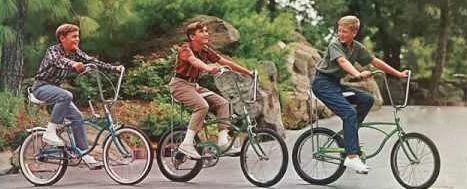
A Bike and a Prayer

I discovered bikes in 1965.  A kid on foot could not hang out for long with kids on bikes.  All it would take was for one of the bike crowd to say "let's go" and off they would pedal to the music of clanking bike chains and tires humming, leaving the more earth-bound far behind.  There was no point in trying to follow, even if the destination was close by.  By the time I or any of my pedestrian cohorts arrived, the bikers would have already drained their delight from the new location and were ready to move on.  A bike meant spontaneity.  Being on foot required planning and forethought.  Any destination took a long time to reach and you still had the walk back.  And by that time you were hungry as all boys are every two hours.

I need one of those...
What was the proportion of mounted to walking kids?  I didn’t know.  All I knew was that enough kids were cruising around the trailer park on bicycles for me to see that I was an exception.  Not in a good way.  I was exceptionally deprived.  I dearly wanted a bike.  No, I needed a bike.  Not just any bike, but a particular one I had found in the ubiquitous Sears catalog.

My exposure to advertising was limited.  We had no TV, did not subscribe to a newspaper and the few radio ads I heard were forgettable.  Besides seeing what other kids had, my primary source for information about STUFF was the Sears ‘Big Book’ catalog.  It came out twice a year and was as thick as the telephone book.  It had everything a person could want.  Clothes, tools, hardware, appliances, electronics, furniture.  If it wasn't in the Sears catalog, you probably didn't need it.

In what seemed just short of magic, Mom  would make a phone call, then goods would arrive at our local Sears store for pickup not many days later.  Sears published smaller seasonal or sale catalogs from time-to-time as well.  Each catalog was no doubt carefully planned for release by a huddle of marketing types in Sears headquarters.  My favorite catalog was the much-anticipated Christmas 'Wish Book' that showed up shortly after Halloween, loaded with toys for children of all ages.  I would sit for hours thumbing through the pages, imagining a paradise with rooms full of toys for my endless pleasure, until the reality of our trailer park life popped my bubble.

Those were the days of wheelie bicycles, a tribute to the motorcycle culture of the 1960's.  Banana seats and high handlebars were in vogue.  'My' bike was painted a glittering gold color.  I saw freedom and speed and power in that bike, reminiscent of a big jungle cat. That bicycle became the focus of all my longings.

"Lil Tiger"
And so I began to pray.  We had been in church for some time by then and I had heard enough preaching and testimony about prayer that it seemed worth a shot.  So every night I would earnestly pray for that bike to become my own with the faith of a 6-year-old.  Then, one day, very near to my birthday, a large box arrived from Sears.  Barely daring to hope, I started an interesting mental game some people play when it appears likely that their dreams will be realized.  I desperately wanted the bike, and was almost certain that it was lurking in that box.  But, I also tried to convince myself it could be any number of other things to hedge against disappointment.  Soon, though, the box was opened and in a nearly-assembled state, there was ‘Lil Tiger’.  I have purchased or been given countless things in the years since.  None have given me nearly the thrill of seeing that bike transformed from a small picture in a catalog to a reality in our tiny trailer living room.  Getting that first bike was more important than getting my first car.  (Of course, my first car was a Mazda GLC, which could just barely go faster than a bike).

How Mom ever came up with the money to get me that bike is a mystery.  Motherhood is full of unseen sacrifices that a child is not even aware of until much, much later.  Somehow, she managed it.  I distinctly remember telling Mom that I had prayed for that bike and I am sure she affirmed my childhood faith.  My reality was that God had given me a bike because I prayed really, really hard.  Perhaps a misguided notion of what prayer and God are about.  Still, my mother had to have faith that whatever corners she had to cut to get that bike would be made up for in some way by the same providential God to whom I attributed the delivery of my bike.  So, in that sense, I was riding on the coat-tails of Mom's faith.  Then, as now, her connection with heaven was more direct than mine.

Between Mom and I and maybe a neighbor, the bike was quickly assembled.  As I was a slightly built 6-year-old with distinctly average physical coordination, learning with training wheels was mandatory.  Not that I cared.

All I saw once I settled into the seat was how perfectly my hands fit around the rubber grips on the handle bars and how my feet fit the pedals.  I took off slowly at first, figuring out how to turn this beast I was mastering.  After a few small circles, I was off.  Riding faster with the silver plastic streamers hanging from the ends of the grips snapping in the turbulence.  It was not long before the training wheels came off and I was truly a free rider.  I don't remember that first moment of balancing on two wheels, but there are few things to compare to the exhilaration of pedaling a bike with the breeze in your face as you and the bike respond to changes in the road: standing up and pumping really hard to get up hills, crouching down and coasting as gravity pulls you faster than you could ever pedal down hills, jamming on the brakes and leaving long skid marks.  I didn't even think about the wear and tear, just about the coolness of the black stripes I was leaving on the pavement or sidewalk.

My gold steed was a faithful companion for many days, weeks and months that stretched into two years.  But, after a wet winter, I hauled the bike out for a ride one spring evening.  My arms, which had stretched comfortably out in front of me when I first got the bike, now had to be bent at the elbows and splayed out to avoid hitting my legs as I peddled.  To cover the same ground that my faithful steed used to race over before required much more effort because of my increased weight and the awkward leverage made necessary by my longer limbs.  My bicycle was suddenly too small.  In the dark of winter, my bicycle had shrunk and with it my affection.

I don't know what happened to my first bike after that.  Maybe it was passed down to my brother for awhile before completely disappearing.  In another couple of years I would have a new bike that fit me.  But that would require a long and unexpected field trip to the desert with a stranger who happened to be my father.

Saturday, March 8, 2014

What Do I Believe?

What do I believe?  I am not ready to revisit that question just yet, since I still hold essentially to what I described at the end of this post almost two years ago.  Instead, I want to share a list of beliefs that I ran across while reading about LIFE magazine's location in the Rockefeller center after watching the movie 'The Secret Life of Walter Mitty'.

In 1962, the center management placed a plaque at the plaza with a list of principles in which John D. Rockefeller Jr. believed, and first expressed in 1941. It reads:
"I believe in the supreme worth of the individual and in his right to life, liberty, and the pursuit of happiness.
I believe that every right implies a responsibility; every opportunity, an obligation; every possession, a duty.
I believe that the law was made for man and not man for the law; that government is the servant of the people and not their master.
I believe in the Dignity of labour, whether with head or hand; that the world owes no man a living but that it owes every man an opportunity to make a living.
I believe that thrift is essential to well ordered living and that economy is a prime requisite of a sound financial structure, whether in government, business or personal affairs.
I believe that truth and justice are fundamental to an enduring social order.
I believe in the sacredness of a promise, that a man's word should be as good as his bond; that character not wealth or power or position – is of supreme worth.
I believe that the rendering of useful service is the common duty of mankind and that only in the purifying fire of sacrifice is the dross of selfishness consumed and the greatness of the human soul set free.
I believe in an all-wise and all-loving God, named by whatever name, and that the individuals highest fulfilment, greatest happiness, and widest usefulness are to be found in living in harmony with His Will.
I believe that love is the greatest thing in the world; that it alone can overcome hate; that right can and will triumph over might."
As heir to the Rockefeller fortune, John clearly thought deeply about making the most of the life and resources he had been given.  For so long, I have drifted along (like Walter Mitty, I suppose) with unspoken assumptions about what is important, but never actually making the effort to articulate the essence of what my life is about.  So, a task for 2014 -- define what I believe.

Thursday, February 20, 2014

DON'T KNOW MUCH

The old Sam Cooke song 'Wonderful World' starts with these three words:
"Don't know much..." 
And as the song unfolds, there is a lot of things he doesn't know much about.  Which just about sums up life.  The more you learn, what you don't know seems to grow exponentially.  But Sam sings of one vital thing he knows about: love.

I managed to squeeze in a few moments for devotional reading this morning and was struck by the importance of 'knowing' the right things.

Jeremiah 9:24 ...let him who boasts boast in this, that he understands and knows me, that I am the Lord who practices steadfast love, justice, and righteousness in the earth. For in these things I delight, declares the Lord.”

Romans 8:26 Likewise the Spirit helps us in our weakness. For we do not know what to pray for as we ought, but the Spirit himself intercedes for us with groanings too deep for words.


Prayer remains a difficult mystery for me after many years.  I don't know God well, I don't know how to pray well.  But if the pangs in my spirit result in more of what God desires -- love, justice, righteousness -- in my world, I can be content with that.

Saturday, February 1, 2014

HAPPILY EVER AFTER

It is, as we will continue to be reminded for the next 13 days, Valentine's month.  Yesterday, I shared a joyful breakfast with a friend whose son wed a delightful young lady in January.  Their start together is captured so well here.  We have high hopes for their 'ever after'.

"Happily Ever After" Disney Corporation
As my wife and I are well into the 'ever after', I have seen how much 'happily' there can be.  Marriage at its finest is so enriching.  Truth be told, though, it isn't 'ever' as in 'forever' happy.  There is a steady accumulation of daily choices resulting in a two becoming one, or in a slow drifting that ultimately leads to two individuals who don't know each other.  Every day I have to choose, because I wake up a slightly different person than I was yesterday, and my bride does as well.  After 32 years, that can be a lot of change.

Do the vows mean something two or three decades later after the bloom of youth has been eroded by work and children and the simple struggle to live?  I have found the vows continue to mean something when I live them in the light of something higher:

"Husbands, love your wives, as Christ loved the church and gave himself up for her… In the same way husbands should love their wives as their own bodies. He who loves his wife loves himself… “Therefore a man shall leave his father and mother and hold fast to his wife, and the two shall become one flesh.” This mystery is profound…"

Pruned in the Garden of Faith

For only the second time since planting roses beside our house 10 or more years ago, I did the annual pruning and feeding.  If there is an opposite of a green thumb (such as a brown thumb) when it comes to horticultural aptitude, I have it.  Which is why the majority of our front yard is drought-resistant rock and other forms of non-living ground cover.  But, I want the rose bushes to live as their fragrance and color are a gift each spring.  So, I have tried to educate myself on the mysteries of the seasonal nurturing.  Ruthlessly cutting back doesn't seem like a very helpful thing to do to a plant that is already dormant from lack of the sun's warmth and light.  Yet, it is.  It produced some lovely, healthy blooms last year after my first attempt at annual pruning.

For some time in my walk of faith, I have been feeling like these rose bushes: lacking light, cut back, and just lately, surrounded by, well 'fertilizer'.  Sometimes I am more thorny than I really have cause to be.  But, I have a flicker of confidence that a spring will come and am trusting in these words:

“I am the true vine, and my Father is the vinedresser… every branch that does bear fruit he prunes, that it may bear more fruit." (John 15).

Sunday, January 12, 2014

Thankful for… a Doughnut?

Modern Manna for the famished office worker
It is another New Year and I am recycling my annual commitment to be more thankful for my blessings large or small and to be less disgruntled with, for example, government shutdowns that disrupt family vacations.  (O.K., letting go of that…)

Last Friday, I neglected to set my alarm, so I woke up 20 minutes later than my highly-regimented morning dictates.  Friday is a running day, so I had to weigh the option of cutting my run short versus skipping breakfast, neither of which were very appealing.  But, life is about choices, as I so often remind my children to their deep gratitude.  I chose to run.  In the back of my mind, a faint hope flickered that maybe someone would bring food into the office.  This happens quite often in the December holiday season, but almost never in the post-Christmas reality-check month of January.  So, perhaps it was less a hope than wishful thinking, or even a faintly desperate prayer.

To compensate for missing breakfast, I tossed an extra apple in my backpack on the way out the door.  Still, by midmorning my apple was gone, my ritual 10 o'clock banana was gone, and my stomach was growling.  At precisely my moment of fainting hunger (play dramatic music here), one of my coworkers came around with a nearly empty box of doughnuts.  Apparently someone from the department next to our I.T. group had brought some in for their peeps and there were a few extra.


There are a lot of bad things you can say about the nutritional benefits of doughnuts.  But, to a man fainting with hunger, it was like manna in the wilderness (a wafer that tasted like honey, Exodus 16:31).  That lovely, puffy, round yeast donut sprinkled lightly with cinnamon sugar tasted marvelous, eased my gnawing hunger, and got me through until lunchtime.  So, on the list of things I am thankful for in 2014, I am putting one, fresh cinnamon sugar doughnut.

Saturday, December 21, 2013

Snakes In The Dark

Other than headlights of passing cars and one or two other regulars who brave the pre-dawn hours to pound the pavement, I am alone as I jog.  I like it that way.  Running takes little thought and my mind is free to consider my day, my life, the cosmos.  For those who need lots of social interaction, this may sound odd, but I have never had enough time by myself to actually get tired of it.  Of course, with my family, I have never had an opportunity to test the limits of solitude.

On my route a few weeks ago, I came upon a surprising sight: a person standing in the middle of the intersection I was approaching, apparently trying to flag cars down.  My first thought was that there was some sort of an emergency.  As I drew closer, I saw under the glare of the street lights that it was a young man, quite agitated, wanting to cross the street but unable to.

He saw me and started to speak from about 30 feet away.  Something about needing to get home and his phone battery was dead.  Then he took a few steps in my direction, which put him right in the traffic lanes.  Although there is not much traffic at that hour, a car had to swerve slightly to avoid him.  I told the young man to get out of the street.  Reluctantly he came over to the sidewalk where I was standing.   He made a distinct effort to appear harmless, intentionally keeping his hands out and up, giving his name, explaining that all he had was his ID, social security card and dead phone. 

Then the story got more complicated.  He had been riding with friends who had been in a car accident.  Apparently no-one was seriously hurt, but the car was inoperable.  Rather than wait around, he had decided to walk home.   I asked where home was, and I don’t remember what he told me.  But, his aunt lived just up the hill in a large apartment complex.  Then it got really interesting. 
“I was going to walk up there, but I’m afraid of the snakes.” 
He was sure he could see snakes in the shadows, which explained why he was standing in the middle of the street where the lights were brightest.  Even standing next to me, he was agitated and kept looking around and asking, “Aren’t you afraid of the snakes?  Can’t you see them?” 
I used the excuse that I wasn’t wearing my glasses and that it was a little hard to see in the dark.  So, how to assess this situation?  Here was a troubled young man that needed to get to his aunt’s house.  And he couldn’t get past the snakes.  What else could I do?  I asked for a little more information about his aunt to gain some assurance that this part of his story was real.  Then I volunteered to walk him the several blocks to his aunt’s place.
That was one of the most unusual walks I have had in a long time.  It only took 10 minutes or so, but most of the time was spent quietly, walking next to a young man who looked furtively at each dark shadow we passed and had to be encouraged to keep walking more than once.
“Don’t you see them?”
                  “No, I didn’t see anything.”
“Are you sure there are no snakes there?”
                  “Yes.  Come on.  You are going to be fine.”
“That’s amazing that you aren’t afraid of them.”
                  “Thanks.  Let’s keep moving.  We’re almost there.”
Once we arrived at the apartment complex, he visibly relaxed.  After navigating through the buildings, we came to the right one.  His aunt lived in an upstairs unit, so we parted at the foot of the stairs.  I shook his hand and wished him well.  He thanked me and headed up the stairs.  I turned and walked briskly away, throwing a glance over my shoulder to make sure he didn’t come back down, not completely certain of my own safety.  My morning routine still waited to be finished and I was going to have to hustle if I was to make my train.

There are any number of psychiatric* or physiological explanations for his ‘snakes’, no doubt.  Drugs, head trauma, genetic disorder.  Maybe his aunt wasn’t all that happy to have him show up at 5 am.  But, all I could think of was that here was a young man, lost, afraid, in the dark.  Now, he was in a safe and familiar place.  Most of us have been there, or maybe are there now: lost or afraid or in the dark, or all three.  Physically or spiritually or both.  And aren’t we thankful for someone who comes along, the unexpected Samaritan, who takes time to bring us back into the light?

Next time, it may be me, it may be you who needs a guide.


*http://en.wikipedia.org/wiki/Peduncular_hallucinosis