Thursday, May 22, 2014

Penny For My Thought?

In God We Trust,
cuz the money ain't worth nuthin!
I was reminded of one of my favorite books while out jogging yesterday morning.  In the glow of the
street lamp, I caught a glimpse of a shiny, new penny.  In less than a stride, in much shorter time than it takes to write this, I thought: "Should I stop to pick it up?  No, it's not worth it.  It's just a hunk of zinc pretending to be copper.  A penny can't buy anything anymore."  So, I left it there.

When I was a kid, pocket change was non-existent.  Mom had no money to spare and I was clueless about how to earn my own.  So, I learned to have a sharp eye for any coins that might be in my path when I was out and about, a habit I carry to this day.  A penny could buy a piece of candy, any larger coin was a treasure.  I can remember distinctly walking back to class from lunch break one day in elementary school and spotting a nickel.  A whole nickel!  Thoughts of what I could do with this small fortune began to dance in my head as I bent down to get it.  But my friend that was with me had seen it as well and swooped down and scooped it before I could.  With all the aggrieved unreasonableness of a 10 year old I said, "Hey, give it to me!  I saw it first."  To which my friend replied, "But I GOT it first."  (Possession is 9/10's of the law...) How I knew I had seen it first is a mystery.  But to this day I am sure I did.  This 'eye for money' served me well many years later.  My wife and I were out with the youth pastor and a crowd of teenagers from our church on a 16 mile walk-a-thon to raise funds for some worthy cause.  I had made it to the end once already and hitched a ride back to help encourage some of the less ambitious (including Mrs. Robidoux).  As we trudged along the side of the road, my eye caught a glimpse of a faded, crumpled green-and-white piece of paper.  Again, my mind raced through the options of "No, it really can't be money.  Think of all the people who have already been by here.  Paper money can't survive being outside very long.  If I pick up a piece of trash I will look stupid."  Still, I stooped down, picked it up, and unfolded a $100 bill.  After donating a portion to the worthy cause, my wife and I had an excellent dinner out that night.  Which, in my mind, more than made up for the nickel I missed out on back in elementary school.

Oh, the book?  Whatever Happened To Penny Candy by Richard Maybury.  It is required reading for our girls when they hit high school.  The author does a great job of explaining why we have a lot more pennies and dollars floating around our economy than a generation ago and why those dollars won't buy nearly as much.  Two personal examples: I grew up with penny candy vending machines that now require a quarter.  The home that cost my father-in-law under $30,000 some 40 years ago would cost ten times that now.  While a penny saved may still be a penny earned (not exactly what Ben Franklin said), my time is worth a lot more than that penny.

Saturday, May 10, 2014

I Would Do It For You, Wouldn't I?

One of the benefits of young adults in the house is that I am exposed to more, MUCH more, contemporary music than I would be if we had an empty nest like other 50-somethings.  Sometimes it feels like psy-ops aimed at subverting the home life my wife and I have tried to establish.  But for the sake of this discussion, I am considering it a benefit.  I get a window into the soul of the next generation and I hear some pretty darn good music that I would miss out on otherwise.  One such song is Gone, Gone, Gone by Phillip Phillips.  It is a pledge of undying love with loads of examples of the lengths the singer will go to prove his love.  I am not a music stylist, but I know what I like in 'pop' music and it tends towards the simple, acoustic, bluesy.  Like this song.  If you want a true musical review, go here.  After listening to Gone, Gone, Gone a few times (well, more than a few times - thank you, dear daughter), I picked up on a subtle truth in the lyrics that struck me.  It may have just been a device used by the writers to bridge between the verses and the chorus, but I noticed something:

Give me reasons to believe
 That you would do the same for me.
 And I would do it for you, for you.

I surrender honestly.
 You've always done the same for me.
 So I would do it for you, for you.

Give me reasons to believe... AND I would do it for you.
You've always done the same for me... SO I would it do it for you.

I checked with my household grammar wizards to confirm that AND and SO are acting as conditional conjunctions.  What the song is communicating then is what I experience.  I want to love those who are dear to me passionately, unreservedly, sacrificially.  But, in spite of my ideals, which are wrapped up in a Christian ethic of love modeled by Jesus, I need something back.  I have a strong martyr complex and can give for a long time with no kudos or reciprocation.  Not forever.  And I have never had to.  I am crazy spoiled with love.  I have never faced what some know all to well: a love that started out with mutual joy and passion that somewhere, somehow became a one-way street to a soul-draining loneliness of endless giving until the well was dry.

Then it occurred to me.  Am I the one holding back, sucking the life out of others without giving them even a sustaining crumb of affection?  In the limits of my human condition, I struggle to express affection.  Today, I want to be awake to the hunger and give back what I have been given.

You've always done the same for me.
So I would do it for you.

Saturday, May 3, 2014

Not Just Another Morning Jog

It is a lonely, quiet time of morning that I run, shortly after the 4 am alarm jerks me awake.  Mostly, I run in solitude, engrossed in thought.  So much so that I can cover miles and not quite remember how I got that far.  Over the past several months, though, I have seen another regular jogger once or sometimes twice a week.  This jogger is a young woman.  At least younger than me.  In the pre-dawn dark, it is hard to tell age, but I can safely assume that a majority of the jogging populace is younger than I and how someone runs says something about their age.  My stride certainly doesn't have the bounce it did 20 years ago.

This young woman comes from the opposite direction, which explains why I see her in the first place.  The likelihood of my overtaking or being overtaken by someone running the same direction is quite remote.  Normally, I see her coming with enough warning to step off the sidewalk and into the bike lane, if I am not there already.  My rule of the road when I jog is to yield to oncoming traffic.  There have been a couple of instances where we nearly plowed into each other, once coming around the corner of the intersection and once because I was off somewhere else mentally and not paying attention.  As we pass, we usually wave and say an abbreviated, slightly winded “G’morning” in the way joggers do.

So, when I saw her coming yesterday morning, I expected the same ritual.  I moved off the sidewalk, but as I approached, she stopped under a street-light and asked a question as I passed by.
"Have you seen the homeless guy?"
I stopped a couple of paces away.  Her hair was tied back in a pony tail and I could see the worry in her face.
"No, I haven't seen anyone."
In the course of a brief conversation, I learned that her route takes her past the intersection where I get on that particular street.  Apparently there is a homeless man who camps out near an office complex along the way.  And that scares her.  Rather, he scares her.  I didn't know what else to say except that I was sorry since I couldn't give her any assurances about the homeless man.  Then we jogged away from each other on our regular routes.

So I finished my run with unexpected thoughts tumbling in my head.    I am just as much a stranger to this young jogger as the homeless man.  Yet, she stopped, spoke to me, and shared her concern.   Somehow, just being polite on the jogging path over the course of a few months builds trust.  She didn't have to stop, she didn't have to say anything.  But she did.  Her fear of one stranger motivated her to speak to another stranger.  As a man, I run alone in the dark with little thought for my safety.  I do not know the fear that she experiences when running alone, so I shot up a prayer for her safety.  Now, I will be wondering how she is until I see her again.  Finally, I was reminded again of the grace that has made my life so different from the “homeless guy” a few blocks away; the grace that lets me enjoy my cozy little home with my delightful family, so different these tattered wanderers who carry their homes in a cart or backpack.  We breathe the same air, we walk the same streets.  Yet one of us is a cause for fear, the other a token of safety.  I have so much to be thankful for.

Saturday, April 26, 2014

Imperatives On The Airplane

While sitting in the long metal tube six miles above the planet on my return flight home from New Jersey last week, I ran out of things to read.  More precisely, I had gone through all the reading material I had brought with me (Escape From Camp 14 and Rose Under Fire).  My active mind began casting about for something to feed on.  I soon realized there are a lot of instructions stuck in various locations on aircraft.


Warning: stand clear of hazard areas while engine is running.
Fortunately, as I had a wing seat, I was neither in front of nor behind the engine.  Not sure what that said about the safety of the other passengers.  But, as long as they don't step outside during flight, they will avoid this potential catastrophe (*Incredibles*).


Fasten seat belt while seated
Presumably this is for those people who try to fasten their seat belt while standing clear of the hazard areas.  Who else would try to fasten a seat belt while NOT seated?


Earn Miles with Biscoff (the crunchy in-flight snack cookie)
Okay.  Suppose someone actually took this seriously.  Imagine the dialogue between the flight attendant and the passenger:
"Sir, I just gave you 10 packages of cookies!"
"I know, but I just need 32 more to earn my next free flight," mumbled Mr. Jones as he stuffed another cookie in his mouth and another wrapper into the seat pocket in front of him.


THE LAVATORY (a.k.a. - restroom)
The MOST IMPORTANT THING is No Smoking in Lavatory as evidenced by the large type and bright red 'no cigarettes' symbol.  Because, cigarette smoke must smell worse than, well, that other stuff you smell in the lavatory.

Why only say 'Please' when telling someone to lock the door?  I mean, is it optional?  I don't want anyone busting in on me while I'm in there, that is for certain.
Open door slowly as there is a crowd waiting outside by the time you are halfway into the flight and some of them are doing the dance and if you bump them there might be an accident.
Latch door closed during taxi, takeoff and landing.  What are you doing in there during takeoff and landing in the first place?  In case you hadn't noticed, there is no seat belt in the lavatory.  
Do not drop bathroom tissue on the floor.  Oh, you didn't see that sign?  That's because the airline is too embarrassed to mention the state of the lavatory after 2 hours in the air.  For any number of reasons I do not want to pick that tissue up for you, nor do I want it stuck to my shoes when I trudge back to my seat where I will stand clear of the hazards, belt myself in, and earn more miles eating cookies.

Saturday, April 19, 2014

A Bike and a Prayer

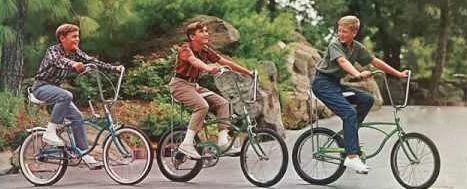
I discovered bikes in 1965.  A kid on foot could not hang out for long with kids on bikes.  All it would take was for one of the bike crowd to say "let's go" and off they would pedal to the music of clanking bike chains and tires humming, leaving the more earth-bound far behind.  There was no point in trying to follow, even if the destination was close by.  By the time I or any of my pedestrian cohorts arrived, the bikers would have already drained their delight from the new location and were ready to move on.  A bike meant spontaneity.  Being on foot required planning and forethought.  Any destination took a long time to reach and you still had the walk back.  And by that time you were hungry as all boys are every two hours.
I need one of those...
What was the proportion of mounted to walking kids?  I didn’t know.  All I knew was that enough kids were cruising around the trailer park on bicycles for me to see that I was an exception.  Not in a good way.  I was exceptionally deprived.  I dearly wanted a bike.  No, I needed a bike.  Not just any bike, but a particular one I had found in the ubiquitous Sears catalog.

My exposure to advertising was limited.  We had no TV, did not subscribe to a newspaper and the few radio ads I heard were forgettable.  Besides seeing what other kids had, my primary source for information about STUFF was the Sears ‘Big Book’ catalog.  It came out twice a year and was as thick as the telephone book.  It had everything a person could want.  Clothes, tools, hardware, appliances, electronics, furniture.  If it wasn't in the Sears catalog, you probably didn't need it.

In what seemed just short of magic, Mom  would make a phone call, then goods would arrive at our local Sears store for pickup not many days later.  Sears published smaller seasonal or sale catalogs from time-to-time as well.  Each catalog was no doubt carefully planned for release by a huddle of marketing types in Sears headquarters.  My favorite catalog was the much-anticipated Christmas 'Wish Book' that showed up shortly after Halloween, loaded with toys for children of all ages.  I would sit for hours thumbing through the pages, imagining a paradise with rooms full of toys for my endless pleasure, until the reality of our trailer park life popped my bubble.

Those were the days of wheelie bicycles, a tribute to the motorcycle culture of the 1960's.  Banana seats and high handlebars were in vogue.  'My' bike was painted a glittering gold color.  I saw freedom and speed and power in that bike, reminiscent of a big jungle cat. That bicycle became the focus of all my longings.

"Lil Tiger"
And so I began to pray.  We had been in church for some time by then and I had heard enough preaching and testimony about prayer that it seemed worth a shot.  So every night I would earnestly pray for that bike to become my own with the faith of a 6-year-old.  Then, one day, very near to my birthday, a large box arrived from Sears.  Barely daring to hope, I started an interesting mental game some people play when it appears likely that their dreams will be realized.  I desperately wanted the bike, and was almost certain that it was lurking in that box.  But, I also tried to convince myself it could be any number of other things to hedge against disappointment.  Soon, though, the box was opened and in a nearly-assembled state, there was ‘Lil Tiger’.  I have purchased or been given countless things in the years since.  None have given me nearly the thrill of seeing that bike transformed from a small picture in a catalog to a reality in our tiny trailer living room.  Getting that first bike was more important than getting my first car.  (Of course, my first car was a Mazda GLC, which could just barely go faster than a bike).

How Mom ever came up with the money to get me that bike is a mystery.  Motherhood is full of unseen sacrifices that a child is not even aware of until much, much later.  Somehow, she managed it.  I distinctly remember telling Mom that I had prayed for that bike and I am sure she affirmed my childhood faith.  My reality was that God had given me a bike because I prayed really, really hard.  Perhaps a misguided notion of what prayer and God are about.  Still, my mother had to have faith that whatever corners she had to cut to get that bike would be made up for in some way by the same providential God to whom I attributed the delivery of my bike.  So, in that sense, I was riding on the coat-tails of Mom's faith.  Then, as now, her connection with heaven was more direct than mine.

Between Mom and I and maybe a neighbor, the bike was quickly assembled.  As I was a slightly built 6-year-old with distinctly average physical coordination, learning with training wheels was mandatory.  Not that I cared.

All I saw once I settled into the seat was how perfectly my hands fit around the rubber grips on the handle bars and how my feet fit the pedals.  I took off slowly at first, figuring out how to turn this beast I was mastering.  After a few small circles, I was off.  Riding faster with the silver plastic streamers hanging from the ends of the grips snapping in the turbulence.  It was not long before the training wheels came off and I was truly a free rider.  I don't remember that first moment of balancing on two wheels, but there are few things to compare to the exhilaration of pedaling a bike with the breeze in your face as you and the bike respond to changes in the road: standing up and pumping really hard to get up hills, crouching down and coasting as gravity pulls you faster than you could ever pedal down hills, jamming on the brakes and leaving long skid marks.  I didn't even think about the wear and tear, just about the coolness of the black stripes I was leaving on the pavement or sidewalk.

My gold steed was a faithful companion for many days, weeks and months that stretched into two years.  But, after a wet winter, I hauled the bike out for a ride one spring evening.  My arms, which had stretched comfortably out in front of me when I first got the bike, now had to be bent at the elbows and splayed out to avoid hitting my legs as I peddled.  To cover the same ground that my faithful steed used to race over before required much more effort because of my increased weight and the awkward leverage made necessary by my longer limbs.  My bicycle was suddenly too small.  In the dark of winter, my bicycle had shrunk and with it my affection.
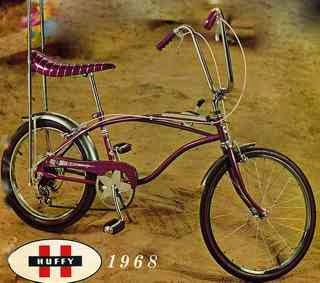
I don't know what happened to my first bike after that.  Maybe it was passed down to my brother for awhile before completely disappearing.  In another couple of years I would have a new bike that fit me.  But that would require a long and unexpected field trip to the desert with a stranger who happened to be my father.

Saturday, April 5, 2014

In The Summertime (1972)

The summer of 1972 was glorious.  The end of the school year was always a source of joy.  To make school bearable, I would begin the count-down on the first day in the fall: how many days until Christmas vacation, then how many more until school was out for the summer.  But that year, summer vacation was more significant than ever.  You see, I had survived 7th grade.

The change from elementary school where I had the exalted status of a 6th-grader to the Junior High where I was a punk 7th grader was shocking.  I was a creature of routine.  One teacher in the same classroom day in and day out was ideal.  Now my school days were spent on a sprawling campus where I had to find a different class room every hour.  There were weeks of wandering with my campus map until I got the hang of it.  And I will not discuss the calamity of P.E. which was only hinted at when the shopping for ‘back to school’ clothes included the purchase of an unusual garment to be worn only for gym class.

Ford Pinto
or was THIS the worst car ever?
Chevy Vega - worst car ever made?
Meanwhile, I had older sisters who were navigating the more sophisticated climes of high school.  Being the 'kid brother' had its drawbacks to be sure.  Older sisters could go places and do things that were only mysteries to the mind of a 12-year-old.  Ford Pintos or Chevy Vegas or equally underpowered thrift-minded cars would appear and my sisters would join their giggling friends and motor down the narrow trailer park access road and disappear towards the entrance.


The Osmonds
Phase 3
Ick...
Three Dog Night
Harmony
Awesome
But occasionally, their friends would stay.  They would hang out in the living room playing Three Dog Night or Chicago or, heaven forbid, the Osmonds, while somehow carrying on a conversation over the blaring speakers of the straining console stereo.  If mother had only known.  But she was at work, where she was every weekday until 5:30 or 6:00 in the evening.  Those hours between the end of school and mother's arrival home were sort of a free-zone from the usual decorum that had to be observed on the return of our sole, overworked parent.  And the usual decorum most definitely did not include rock ’n’ roll.

Need more bell...
What straight hair was all about.
An awareness came to me that these female friends of my sisters were — aside from their propensity for loud and laughter-punctuated talk that made absolutely no sense whatsoever — interesting in a way that the girls at school were not.  It was the era when long, straight hair was required on girls, and straight-legged jeans were absolutely outcast.  A large amount of time was spent straightening hair and sewing extra denim into the legs of jeans so they would be transformed into massive bell-bottoms.  

In the summertime, the visitors came more frequently.  School had ended.  The sun and Coppertone® were out in force.  Jeans gave way to cutoffs.  And halter-tops. And bikinis.  Until that summer, I may have only been vaguely aware that the surface area of a person had so much skin.  (Something in the neighborhood of 17 square feet.  Do the math.)

Before 'SPF'
Skin looked so much better on tanned girls than it did on my pale, scrawny physique.  So when my sisters had visitors, I would find all sorts of excuses to make the trek from my room (where I was by an unwritten protocol imprisoned due to my complete uncoolness) to the kitchen at the opposite end of our boxy trailer,  whereby I had to pass through the intoxicating sanctum of music and teenage femininity.  The sights and sounds.  The unconscious gesture of a girl's hand flipping a wisp of hair back over her shoulder was enough to make me stumble.  Should one of them look my direction, my mouth would suddenly parch.  I would swallow hard.  Sure, there were girls in Junior High, but they merely hinted at the promise that these companions of my sisters embodied: womanhood in full bloom.


Tanned,
lovely,
high school girl.
On my return trip to the meagre bedroom I shared with my brother, I would occasionally hear whispered tones and quiet giggles.  A suspicion came to me that perhaps I was the unfortunate cause of their mirth.  Still, I told myself, it had to be better to be noticed than to remain invisible and virtually non-existent.  

I had not progressed much beyond that awkward, tongue-tied state several years later when I met another tanned, lovely high school girl.  Providentially, she knew how to carry a conversation that continues to this day.


Saturday, March 15, 2014

Sunday Night Missionary Service

After God found our family, it was not long before Mom molded our family life to the rhythms of the little Assembly of God.  Several of the founders were originally from Arkansas, giving this simple Pentecostal church in a rural community the flavor of a Bible-Belt transplant.  Sunday morning services were much the same each week with the exception of the first Sunday of the month when communion was served.

Sunday nights were a different matter.  Pastors are busy fellows.  Coming up with two barn-burning sermons in one day requires a lot of preparation, so most Sunday night services were a catch-all for an assortment of special guests: evangelists, musical groups and missionaries.  Missionaries became, in my mind, the true heroes of the faith.  I learned about the missionary journeys of the Apostle Paul in Sunday School and read the biography of David Livingstone and other missionaries of times gone by.  But there was nothing like hearing about missionary work first hand.

There were good missionary services and dull ones.  The best were like a trip to a museum with a knowledgeable curator.  The worst were when the missionary just preached a ‘regular’ sermon.  After all, I could get that any Sunday night.  For a elementary school age boy, little could compare to the wonder of arriving at church on a Sunday night to see the communion table swept clear of its normal accoutrements and in its place a collection of foreign artifacts spread out for our wondering eyes: animal hides, musical instruments, weapons, eating utensils (and sometimes food), clothing.  The most creative missionaries would dress in the native garb of the mission country.  Typically, their first words would be in the language of the land they were serving, followed by a translation into English.  I had no way to verify anything they said, but that didn’t matter.  Their stories included all the strangeness of a foreign people, rare diseases, grinding poverty, odd foods, occasional violence, dangerous animals, and of course, testimonies of converts.  A slide show or movie would take me places that I would never otherwise visit.  My first exposure to the Third World was through the lens of a missionary camera.


Missionaries were not just there for my entertainment, however.  They had to raise support to get back to their work.  At the end of their presentation, the pastor would come back to the podium and it was time for the missionary offering.  As a child, I rarely had money.  But I remember wanting to give.  Souls were hanging in the balance.  Still, after hearing their tales, the boy I was wondered why people would choose to go.  It all came down to ‘The Call’.  Missionaries had invariably experienced an irresistible internal beckoning to a foreign people.  They often encouraged those in the service to be open to a similar experience.  I never heard that call to head out for parts unknown.  I felt both guilty and relieved.  Guilty, because I knew I should want the lightening to strike me as it did the Apostle Paul; relieved, because I was given to car-sickness and international travel by ship, air, or rail seemed a sure path to an early grave, even before I reached the destination.